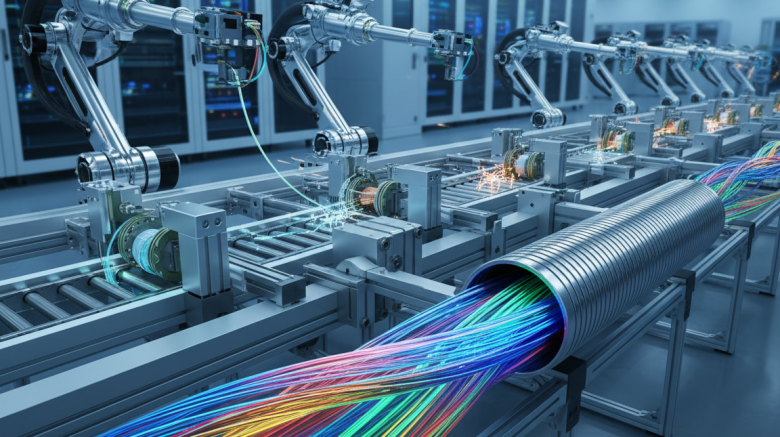
The FTTH cable production line is a coordinated suite of modules that transforms fiber optic glass into finished drop and distribution products with repeatable quality.
SZ stranding line
This introduction guides plant managers, process engineers, sourcing teams, and students in the United States market who evaluate how factory manufacturing systems converts delicate fiber into robust cables for service and communication networks.
Fundamentally, the end-to-end objective is clear: safeguard the fiber, maintain low optical loss, build in installation strength, and ship an output that holds up to inside and outside exposure.
Expert equipment means stable tension control, synchronized motion control, defined process windows, and clear documentation for acceptance testing. This article helps align the line setup, materials, and validation plan to the desired cable design instead of purchasing machines first and fixing the process later.
You’ll map stages such as fiber handling and preparation, buffering and coating, organization/stranding, strength member integration, sheathing (outer-jacket extrusion), optional armor integration, and final testing and packaging.
Key points: A properly specified line minimizes defects and supports predictable delivery. Align the process before buying machines to save time and cost.
How A Modern Fiber Optic Cable Production Line Works
Where last-mile drop and distribution demands meet factory practice.
Today’s fiber manufacturing lines turn delicate glass into finished products used in U.S. broadband rollouts. Rising last-mile drop and FTTH drop demand pushes high volumes, so manufacturers focus on consistent handling and compliance with standards.
Core Modules & Material Flow
Material moves through a clear sequence: pay-off → guiding and tensioning → secondary coating and coloring → organization / SZ stranding → strength member feed → jacketing and sheathing → cooling/curing → take-up plus testing.
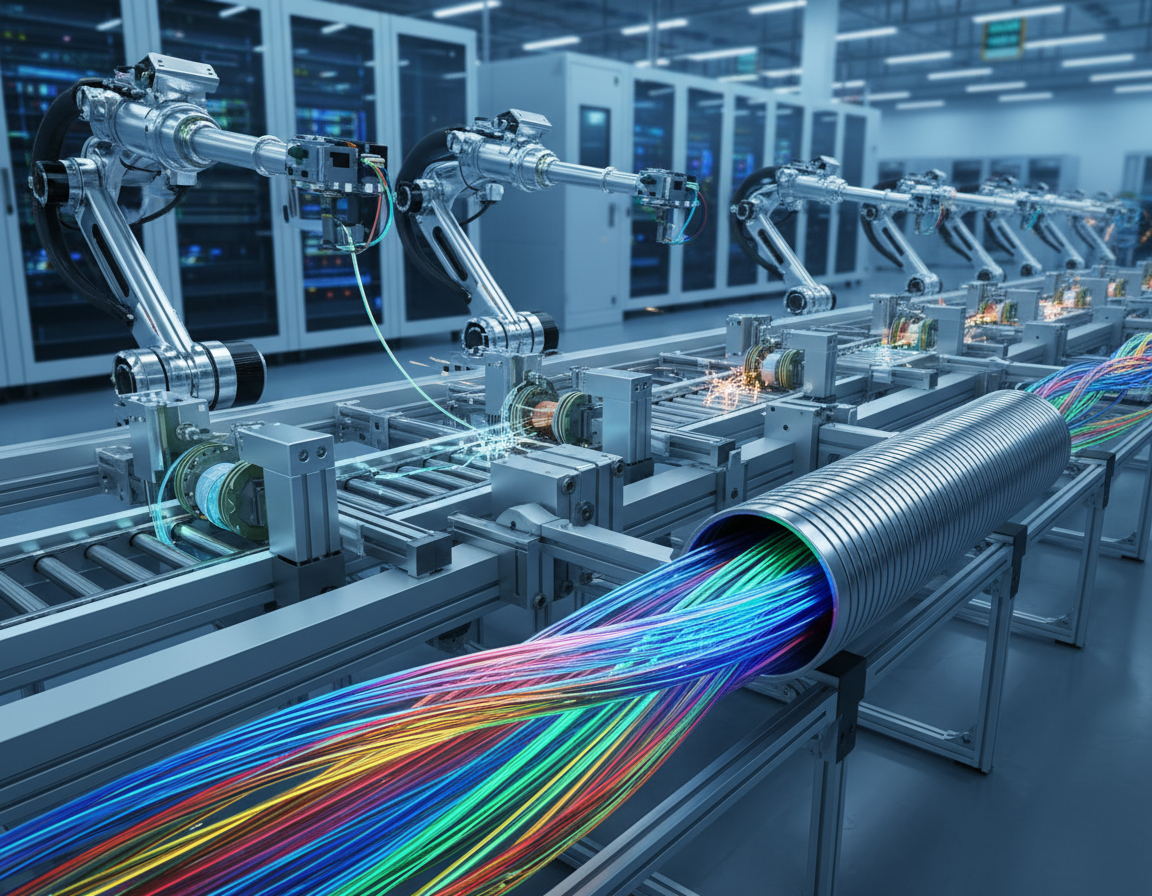
Modules → Outcomes
Consistent fiber handling reduces attenuation and protects signal integrity for data and communications. Consistent jacketing aids installation and connector preparation. In-line monitors detect loss events before reels leave the line.
- Indoor vs. outdoor applications: different buffering and jacket compounds.
- Armored variants add steel tape or wire for rodent and crush resistance.
- Drop designs favor tight-buffered fibers and simplified connector prep.
Buyers should view lines as modular. Factories can add armoring or remove steps to match the cable design. Output limits often come from curing and dimensional stability, not simply motor speed.
Define Your Product And Data Standards Before You Buy Equipment
Kick off with a clear product definition that defines the cable type, fiber/core count, service environment, and user scenarios. Early definition limits which modules the line needs, from tight-buffer units to SZ stranding capability and jacket extrusion.
Select Standards & Measurable Targets
Choose fiber standards such as ITU-T G.652D or bend-insensitive G.657A1/A2 based on bend requirements and routing constraints. Document optical loss budgets, tensile strength, crush and bend limits, and environmental durability before vendor selection.
- Identify the precise product type and fiber/core count so you can define modules and control requirements.
- Specify attenuation (loss) budgets and mechanical strength targets to guide material choice.
- Define required materials (buffer polymers, jacket compounds) and confirm U.S. supplier availability.
Data Standards, Traceability & Validation
Turn targets into factory-ready information: recorded process variables, lot-level traceability, and test reports customers require for acceptance. Plan R&D pilot runs to validate settings and shorten scale-up time.
Fiber Draw Tower
| Target | Manufacturing Implication | Typical Response |
|---|---|---|
| Minimal attenuation | Tension + alignment control | Inline attenuation monitoring |
| Higher tensile strength | Strength-element selection | Integrate aramid or metal |
| Improved bend resistance | Choice of fiber type | Adopt G.657 variants |
Build Quality Into The Optical Fiber: Core, Cladding, And Coating Essentials
Strong optical performance begins in the glass, where core purity and cladding design define the boundaries for loss.
Core + cladding create the central layer structure: an ultra-pure silica core carries the light while a lower-index cladding keeps it confined. This geometry underpins low-loss transmission and stable optical behavior once cabled.
From Preform To Drawn Glass Fiber
Manufacturing begins with preform laydown and consolidation. Removing moisture in a high-temperature furnace reduces defects that increase attenuation.
Drawing pulls the glass into a micron-scale strand. Geometry control at this stage directly supports stable attenuation and predictable transmission performance. One blank can produce roughly 5 km of fiber, so stability saves time and cost.
Primary Coating & Color Coding
The primary coating protects against scratches and handling damage; it is not the main tensile element. Color identification simplifies splicing, troubleshooting, and downstream fiber management.
- Preform consolidation: remove contaminants and moisture.
- Draw: manage diameter and tension for low attenuation.
- Coating and color: protect and identify each fiber.
| Layer Element | Role | Buyer check |
|---|---|---|
| Core | Transmit light with minimal attenuation | Define purity and loss specifications |
| Optical cladding | Confine light and control modal behavior | Verify index profile and geometry |
| Primary coating layer | Scratch protection; color ID | Verify adhesion and color coding |
FTTH Cable Production: Step-By-Step Line Setup From Buffering To Sheathing
A practical line setup takes each fiber from pay-off through buffering, stranding, and the outer jacket to a finished reel.
Secondary coating plus fiber coloring stations apply dual-layer UV-cured coatings (≈250 µm) and 1–12 channel color coding for traceability. Stable UV curing and web tension reduce mix-ups and rework.
Buffering And Materials
Tight buffering (600–900 µm) protects handling and simplifies connector work. Selecting Hytrel, PVC, or LSZH affects flexibility, temperature range, and flame/smoke performance.
SZ Stranding & Organization
SZ stranding uses alternating lay to balance geometry and give cable flexibility. Servo control (up to 24 fibers) keeps lay pitch consistent and lowers loss risk.
Strength Members & Jacketing
Aramid yarn is the standard tensile element; it provides pull strength without stressing the fibers during installation.
Outer jacket extrusion using PVC, PE, or LSZH follows. Speeds often run 60–90 m/min and demand tight OD and concentricity control.
Armoring, Control Points
If crush or rodent resistance is needed, add steel tape or wire armor with adjustable tension. Operators monitor tension, cure state, concentricity, OD, and cooling to maintain quality.
| Process Step | Primary Control | Typical Range |
|---|---|---|
| Secondary coating stage | UV cure plus tension | ≈250 µm, consistent cure |
| Tight buffering | Material selection | 600–900 µm (Hytrel/PVC/LSZH) |
| Sheathing | OD/concentricity | 60–90 m/min typical |
Optimize Production Speed And Process Control With Modern Automation
When factories run for 24/7 output, synchronized controls and tension systems become the backbone of reliable manufacturing.
PLC, HMI, Closed-Loop Tension For Steady Operation
Modern lines use Siemens PLC + HMI platforms to synchronize modules, manage recipes, and record process information. Closed-loop tension control safeguards fiber during start/stop events and speed changes.
Fiber Draw Tower
Match Speed To Curing And Dimensional Control
Line speed is often limited where curing, cooling, or extrusion dimensional control falls behind. UV cure completeness, water trough stability, and chill capacity set the real ceiling.
Layout, Changeover, Procurement
Factory layout affects uptime: correct pay-off/take-up placement and protected fiber paths reduce damage and speed changeovers.
- Use quick-change tooling and documented setup steps to speed changeovers.
- Specify industrial power (380 V AC ±10%) and a typical ≤55 kW load when ordering equipment.
- Require remote diagnostics, parts availability, and service response from the equipment company.
| Focus Area | Operational Outcome | Typical Standard |
|---|---|---|
| Module synchronization | Reduced scrap and repeatable runs | Siemens PLC/HMI |
| Closed-loop tension | Protects fiber; stable loss | High-accuracy closed-loop |
| Layout & changeover | Less downtime | Quick-change tooling, staging |
Testing And Quality Control To Reduce Loss And Improve Delivery Reliability
Robust testing and clear quality control convert raw fiber into reliable, field-ready cable reels.
Start with optical verification. Inline attenuation testing and return loss checks confirm signal performance before reels leave the line.
Optical Checks And Signal Integrity
Attenuation testing is the main guardrail against performance complaints. Higher loss values typically point to handling damage, microbends, or contamination.
Return loss checks target reflections that can affect sensitive links and tight network margins.
Mechanical And Environmental Validation
- Tensile pull tests verify strength members and installation safety.
- Crush and bend tests simulate real-world installation stresses.
- Temperature cycling, moisture soak, and vibration tests reduce risk for outdoor and aerial routes.
| Test Type | Why It’s Done | Typical Decision |
|---|---|---|
| Attenuation | Measure loss per kilometer | Pass/fail versus spec |
| Mechanical | Confirm pull/crush/bend performance | Installation rating |
| Environmental tests | Recreate field conditions | Durability confirmed |
Traceability ties raw material lots, in-line data, and final test results to reel IDs. Proper reeling, labeling, and protective packaging protect quality and accelerate customer acceptance and delivery.
Conclusion
A clear manufacturing plan ties product targets to the exact line modules and control limits needed for reliable output. Define the intended FTTH product, service environment, and measurable specs before selecting equipment or layout.
Fiber optic fundamentals—core, cladding, and coating—set the optical baseline. Careful handling upstream preserves data integrity and keeps end-product quality within acceptance limits.
Configure buffering, organization/stranding, strength members, and jacket choices to match installation realities. Use automation and closed-loop controls to hold speed, cut scrap, and make delivery predictable in U.S. markets.
Operational discipline matters: implement comprehensive testing, reel-level traceability, and documented quality systems so customers can accept reels quickly. Next step: convert these points into a purchasing checklist (spec targets, utilities, layout, and acceptance tests) before requesting quotes or conducting trials.